小白学Java——面向对象编程(知识点整理3)
发表时间:2022-03-25来源:网络
第一节 继承下的构造方法
1.1 继承情况下构造方法的调用过程
继承条件下构造方法的执行顺序
构造方法的第一条语句默认是super(),含义是调用父类无参数的构造方法构造方法的第一条语句可以显式的指定为父类的有参数构造方法:super(.....)构造方法的第一条语句可以显式的指定为当前类的构造方法:this(.....)注意事项
每个类最好要提供无参数的构造方法构造方法的第一条语句可以是通过super或者this调用构造方法,须是第一条语句构造方法中不能同时使用super和this调用构造方法,并不是说不能同时出现this和super【示例1】继承情况下构造方法的调用过程
package com.bjsxt.constructorDemo; public class Test1 { public static void main(String[] args) { S s =new S(); } } class F{ /*public F(){ System.out.println("父类中无参的构造方法"); }*/ public F(int i){ System.out.println("父类中有参数的构造方法"); } static { System.out.println("父类中的静态代码块"); } { System.out.println("父类中的普通代码块"); } } class S extends F{ /* * 构造方法不能被子类继承 * 子类的构造方法一定会调用父类的构造方法 * 在子类的构造方法中,使用super()的形式默认调用父类无参构造方法 * 当父类中没有无参构造方法时,子类构造方法中必须显示书写super()并传入实参 * super()必须是子类构造放的第一行 * * 当父类中没有无参构造方法, 那么子类的构造方法中 要么就只能调用父类构造方法,要么就只能调用其他构造方法 * */ public S (){ // 调用父类无参数构造方法 super(10); System.out.println("子类中无参构造方法"); } public S(int i){ this(); } static { System.out.println("子类中的静态代码块"); } { System.out.println("子类中的普通代码块"); } }继承中的代码块执行顺序
package com.bjsxt.extendsDemo2; public class Test1 { public static void main(String[] args) { new C(); new C(); } } class A{ { System.out.println("A code block"); } static{ System.out.println("A static code block"); } public A(){ System.out.println("A constructor"); } } class B extends A { { System.out.println("B code block"); } static{ System.out.println("B static code block"); } public B(){ System.out.println("B constructor"); } } class C extends B { { System.out.println("C code block"); } static{ System.out.println("C static code block"); } public C(){ System.out.println("C constructor"); } }第二节 多态
多态(polymorphism)是面向对象三大特征之一。同一行为,通过不同的子类,可以体现出来的不同的形态。
2.1 引入和使用多态
多态指的是同一个方法调用,由于对象不同可能会有不同的行为。现实生活中,同一个方法,具体实现会完全不同。 比如:同样是调用人的“休息”方法,张三是睡觉,李四是旅游,王五是听音乐; 同样是调用人“吃饭”的方法,中国人用筷子吃饭,英国人用刀叉吃饭,印度人用手吃饭。
编译器类型指的是‘=’左边的类型,运行期类型指的是‘=’右边的类型。当有继承关系时,可能发生编译期类型和运行期类型不同的情况,即编译期类型是父类类型,运行期类型是子类类型。即:父类引用指向子类对象
多态的要点:
1. 多态是方法的多态,不是属性的多态(多态与属性无关)。
2. 多态的存在要有3个必要条件:继承,方法重写,父类引用指向子类对象。
3. 父类引用指向子类对象后,用该父类引用调用子类重写的方法,此时多态就出现了。
使用父类做方法的形参和返回值,是多态使用最多的场合。即使增加了新的子类,方法也无需改变,符合开闭原则。
父类引用做方法的形参,实参可以是任意的子类对象,可以通过不同的子类对象实现不同的行为方式。另外即使增加了新的子类,方法也无需改变,提高了扩展性,符合开闭原则。
扩展: 面向对象的设计原则之一:开闭原则OCP◇ 对扩展开放,对修改关闭
◇ 更通俗翻译:软件系统中的各种组件,如模块(Modules)、类(Classes)以及功能(Functions)等,应该在不修改现有代码的基础上,引入新功能
◇ 面向对象设计需要遵守的最高原则,也是最终目标
2.2 多态之向上转型
将子类对象赋给父类引用,称为向上转型(upcasting),自动进行类型转换。向上转型可以调用的子类继承的方法,但不能调用子类特有的方法。需要特别理解的是如果子类重写了父类的方法,向上转型后通过父类引用调用的却是真实子类重写的方法
【示例2】 向上转型
package com.bjsxt.polymorphismDemo1; public class Test1 { public static void main(String[] args) { /* F f =new F(); f.eat(); S1 a =new S1(); a.eat();*/ /* * 子类可以声明成父类对象 应为子类完全拥有父类的属性和方法 * * 1子类声明成父类对象 在调用方法时,执行的是子类重写父类的方法 * 2子类声明成父类对象 只能调动父类中声明过的方法,不能调用子类中自定义的方法 * * 子类声明成父类对象 编译时认为是父类对象 只能调用到父类中声明过的方法 * 运行时认为是子类,运行子类中重写的父类的方法 * * */ // F f=new S3(); // f.eat(); // // f.play(); teatA(new S1()); } public static void teatA(F f){ f.eat(); } } class F{ public void eat(){ System.out.println("吃大米"); } } class S1 extends F{ public void eat(){ System.out.println("吃面条"); } public void play(){ System.out.println("打游戏"); } } class S2 extends F{ @Override public void eat() { System.out.println("吃饺子"); } } class S3 extends F{ @Override public void eat() { System.out.println("吃馒头"); } } class S4 extends F{ @Override public void eat() { System.out.println("吃烤肉"); } }2.3 多态之向下转型
将父类的引用变量转换为子类类型,称为向下转型(downcasting)。向下转型后就可以调用子类特有的方法了。
◆ 需要进行强制转换Chinese ch = (Chinese)pro;
◆ 强制转换不是做手术,必须转换成真实子类型,否则ClassCastException;
◆ 向下转型之前肯定发生了向上转型
◆ 为了避免ClassCastException,向下转型之前使用instanceof先判断一下
pro instanceof Italian
对象 instanceof 类或者接口
使用instancof的前提:左边的对象和右边的类型在继承树上有上下级关系
【示例3】向下转型
package com.bjsxt.polymorphismDemo2; public class Test1 { public static void main(String[] args) { /* * 父类对象一般不能声明成子类对象 父类不具备子类的功能 * 可以通过强制转换将父类对象转为子类对象 通过编译 * 如果父类对象原本就是由子类声明而成的,那就可以转换回子类 * */ F f =new S1(); S1 s1 =(S1)f; methodX(new S3()); } public static void methodX(F f){ // 如何判断传入的对象到底是哪个子类的对象呢? // instanceof 判断一个对象是否属于某个类 System.out.println(f instanceof S1); System.out.println(f instanceof S2); System.out.println(f instanceof S3); System.out.println(f instanceof S4); } } class F{ public void eat(){ System.out.println("吃大米"); } } class S1 extends F{ public void eat(){ System.out.println("吃面条"); } public void play(){ System.out.println("打游戏"); } } class S2 extends F{ @Override public void eat() { System.out.println("吃饺子"); } } class S3 extends F{ @Override public void eat() { System.out.println("吃馒头"); } } class S4 extends F{ @Override public void eat() { System.out.println("吃烤肉"); } }2.4抽象方法和抽象类
·抽象方法
使用abstract修饰的方法,没有方法体,只有声明。定义的是一种“规范”,就是告诉子类必须要给抽象方法提供具体的实现。
·抽象类
使用abstract修饰的类。通过abstract方法定义规范,然后要求子类必须定义具体实现。通过抽象类,我们就可以做到严格限制子类的设计,使子类之间更加通用。
问题1:Animal an = new Animal();没有一种动物,名称是Animal,所以Animal不能被实例化
解决:抽象类
问题2:子类必须重写父类的某个方法,否则出现编译错误
解决:抽象方法
抽象类的使用要点:
有抽象方法的类只能定义成抽象类抽象类不能实例化,即不能用new来实例化抽象类。抽象类必须有构造方法,创建子类对象的时候使用一个抽象类至少0个抽象方法,至多(所有的方法都是抽象方法)个抽象方法子类必须重写父类的抽象方法,不重写就提示编译错误;或者子类也定义为抽象类override 重写 implements 实现父类的方法是抽象的,需要子类实现;父类的方法不是抽象的,子类可以重写
第三节 Object类和组合关系
3.1 Object类的介绍
Object类是所有Java类的根基类,也就意味着所有的Java对象都拥有Object类的属性和方法。如果在类的声明中未使用extends关键字指明其父类,则默认继承Object类。Object类中定义了一些JAVA所有的类都必须具有的一些方法
面试题目:请你写出Object类的6个方法
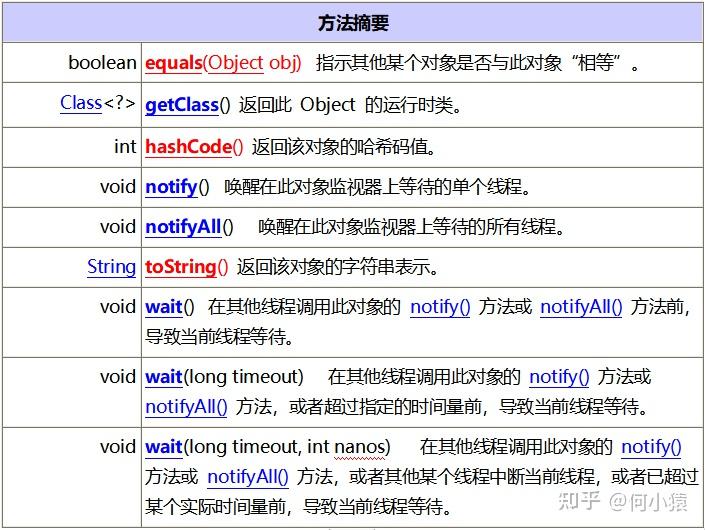
以上方法是Object类的所有方法吗?不是 是Object类所有的public方法。 除此之外可能还有private、protected、默认的方法
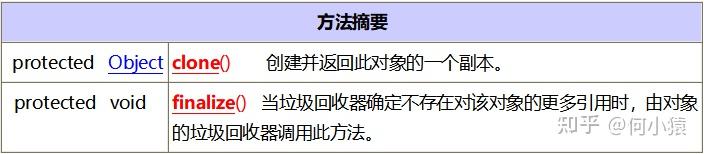 扩展:native关键字
□ 一个native方法就是一个Java调用非Java代码的接口。一个native方法是指该方法的实现由非Java语言实现,比如用C或C++实现。
□ 在定义一个native方法时,并不提供实现体,因为其实现体是由非Java语言在外面实现的。Java语言本身不能对操作系统底层进行访问和操作,但是可以通过JNI接口调用其他语言来实现对底层的访问。
□ JNI是Java本机接口(Java Native Interface),是一个本机编程接口,它是Java软件开发工具箱(Java Software Development Kit,SDK)的一部分。JNI允许Java代码使用以其他语言编写的代码和代码库。Invocation API(JNI的一部分)可以用来将Java虚拟机(JVM)嵌入到本机应用程序中,从而允许程序员从本机代码内部调用Java代码。
3.2 ==和equals方法
“==”代表比较双方是否相同。如果是基本类型则表示值相等,如果是引用类型则表示地址相等即是同一个对象。
Object类中定义有:public boolean equals(Object obj)方法,提供定义“对象内容相等”的逻辑。比如,判断两个Dog是否是一个Dog,要求color、age、nickName等所有属性都相同。
Object 的 equals 方法默认就是比较两个对象的hashcode,是同一个对象的引用时返回 true 否则返回 false。显然,这无法满足子类的要求,可根据要求重写equals方法。
测试==
public class Test1 { public static void main(String[] args) { /* * == * 两端如果是基本数据类型,那么就是单纯判断值是否相同 * 两端是引用类型,那么判断的引用的地址是否相同,判断是否指向内存上的同一个数据 * */ int a=10; int b=10; System.out.println(a==b); String s =new String("asdf"); String s2=new String("asdf"); System.out.println(s); System.out.println(s2); System.out.println(s==s2); String s3="abc"; String s4="abc"; System.out.println(s3==s4); System.out.println(s.equals(s2)); System.out.println(s3.equals(s4)); } }【示例7】重写equals方法
package com.bjsxt.objectDemo1; import com.bjsxt.homework.Person; import java.util.Objects; public class Test2 { public static void main(String[] args) { Dog d1=new Dog("金毛","金黄",10); Dog d2=new Dog("金毛","金黄",10); System.out.println(d1==d2); /** * 判断自定义类的两个对象属性值是否全部相同 * 重写equals方法即可 alt+insert * 使用equals方法去判断 * */ System.out.println(d1.equals(d2)); String s1 =new String("asdf"); String s2 =new String("asdf"); System.out.println(s1==s2); System.out.println(s1.equals(s2)); } } class Dog{ private String type; private String color; private int month; public void showInfo(){ System.out.println(color+"颜色的"+month+"个月的"+type); } // alt +insert @Override public boolean equals(Object o) { if (this == o) { return true; } if (o == null || getClass() != o.getClass()){ return false; } Dog dog = (Dog) o; return month == dog.month && Objects.equals(type, dog.type) && Objects.equals(color, dog.color); } public Dog() { } public Dog(String type, String color, int month) { this.type = type; this.color = color; this.month = month; } public String getType() { return type; } public void setType(String type) { this.type = type; } public String getColor() { return color; } public void setColor(String color) { this.color = color; } public int getMonth() { return month; } public void setMonth(int month) { this.month = month; } }3.3 hashCode方法
哈希码:hash码,散列码,是一种无序不重复的一串十六进制数据,Object类中定义的方法作用就是为每一个对象生成一个独立的哈希码,用以区分每个对象,我们可以通过重写的方式自定义哈希码的声明规则,让其和属性值相关联.一般在重写equals方法时,都会重写hashcode方法
【示例8】重写hashCode方法
package com.bjsxt.objectDemo2; import java.util.Objects; public class Test1 { public static void main(String[] args) { Dog d1=new Dog("金毛","金黄",10); Dog d2=new Dog ("金毛","金黄",10); System.out.println(d1==d2); System.out.println(d1.equals(d2)); System.out.println(d1.hashCode()); System.out.println(d2.hashCode()); } } class Dog{ private String type; private String color; private int month; public void showInfo(){ System.out.println(color+"颜色的"+month+"个月的"+type); } @Override public boolean equals(Object o) { if (this == o) return true; if (o == null || getClass() != o.getClass()) return false; Dog dog = (Dog) o; return month == dog.month && Objects.equals(type, dog.type) && Objects.equals(color, dog.color); } // 只要对象的属性值相同,返回的哈希码就是相同的 @Override public int hashCode() { return Objects.hash(type, color, month); } public Dog() { } public Dog(String type, String color, int month) { this.type = type; this.color = color; this.month = month; } public String getType() { return type; } public void setType(String type) { this.type = type; } public String getColor() { return color; } public void setColor(String color) { this.color = color; } public int getMonth() { return month; } public void setMonth(int month) { this.month = month; } }3.4 toString方法
Object 类中定义类一个方便我们快捷查看对象属性信息的一个方法,toString的目的是返回一个对象的字符串表达形式,Object类中定义的方法规则为类的全路径名+哈希码,我们可以通过重写的方式重新定义该方法
【示例9】重写toString方法
package com.bjsxt.objectDemo2; import java.util.Objects; public class Test1 { public static void main(String[] args) { Dog d1=new Dog("金毛","金黄",10); Dog d2=new Dog ("金毛","金黄",10); System.out.println(d1==d2); System.out.println(d1.equals(d2)); System.out.println(d1.hashCode()); System.out.println(d2.hashCode()); String d1String = d1.toString(); System.out.println(d1String); } } class Dog{ private String type; private String color; private int month; @Override public boolean equals(Object o) { if (this == o) return true; if (o == null || getClass() != o.getClass()) return false; Dog dog = (Dog) o; return month == dog.month && Objects.equals(type, dog.type) && Objects.equals(color, dog.color); } // 只要对象的属性值相同,返回的哈希码就是相同的 @Override public int hashCode() { return Objects.hash(type, color, month); } @Override public String toString() { return "Dog{" + "type='" + type + '\'' + ", color='" + color + '\'' + ", month=" + month + '}'; } public Dog() { } public Dog(String type, String color, int month) { this.type = type; this.color = color; this.month = month; } public String getType() { return type; } public void setType(String type) { this.type = type; } public String getColor() { return color; } public void setColor(String color) { this.color = color; } public int getMonth() { return month; } public void setMonth(int month) { this.month = month; } }原型模式:根据一个原型克隆出多个属性相同但是在内存上是独立的对象
创建一个Dog类 实例化Dog 对象,思考如何通过一个Dog对象复刻出多个属性值相同的Dog对象 ,通过clone方法(浅克隆)完成
package com.bjsxt.objectDemo; import java.util.Objects; public class Dog implements Cloneable{ private String type; private String color; private int month; @Override public Object clone() throws CloneNotSupportedException { return super.clone(); } @Override public String toString() { return "Dog{" + "type='" + type + '\'' + ", color='" + color + '\'' + ", month=" + month + '}'; } public Dog(String type, String color, int month) { this.type = type; this.color = color; this.month = month; } public Dog() { } public String getType() { return type; } public void setType(String type) { this.type = type; } public String getColor() { return color; } public void setColor(String color) { this.color = color; } public int getMonth() { return month; } public void setMonth(int month) { this.month = month; } } 测试代码 package com.bjsxt.objectDemo; public class Test2 { public static void main(String[] args) throws CloneNotSupportedException { /* * clone * 1直接重写即可 * 2要克隆的对象的所属类必须实现 Cloneable接口 * 3clone方法重写后,推荐将访问修饰符修改为public * * */ Dog d1=new Dog("金毛","金色",10); System.out.println(d1); Dog d2=(Dog)d1.clone(); System.out.println(d2); System.out.println(d1==d2); d2.setType("泰迪"); System.out.println(d1); System.out.println(d2); } }知识阅读








软件推荐
更多 >-
 查看
查看计支宝app下载v3.1.29 安卓版
142.27MB |商务办公
-
 查看
查看小小优酷最新版下载v5.4.6 安卓官方版
68.11MB |影音播放
-
 查看
查看艺图语app下载v3.3.4 安卓免费版
34.33MB |系统工具
-
查看
爱鸽者手机版下载v3.2.9 安卓版
243.57MB |商务办公
-
 查看
查看一品威客网接单app(一品众包)下载v2.7.1 安卓最新版
55.01MB |商务办公
-
 查看
查看诸葛找房网官方版下载v4.8.1.1 安卓最新版
66.6MB |生活服务
-
 查看
查看皓盘云建最新版下载v9.0 安卓版
53.38MB |商务办公
-
 查看
查看ris云客移动销售系统最新版下载v1.1.25 安卓手机版
42.71M |商务办公




-
1

-
2
葫芦侠三楼最新破解版下载v4.4.0.6 安卓版
其它手游 -
3
葫芦侠7楼破解版免费下载v4.4.0.6安卓最新版
其它手游 -
4
葫芦侠八楼免费版下载v4.4.0.6安卓版
其它手游 -
5
葫芦侠3楼破解版免费下载v4.4.0.6安卓手机版
其它手游 -
6
像素漫斗抱歉,“八神庵”是特指游戏角色的专有名词,不存在符合要求的常用同义词近义词。下载v1.00安卓版
其它手游 -
7
葫芦侠4楼破解版游戏修改器下载v4.4.0.6安卓免费版
其它手游 -
8
末日餐厅安卓版下载v1.35安卓版
其它手游 -
9
葫芦侠十楼免费破解版下载v4.4.0.6安卓版
其它手游 -
10
葫芦侠8楼最新破解版下载v4.4.0.6安卓版
其它手游